Top
Week 2
Learning Aims and Objectives:
Aim:
In this week's page, students will learn how UK and international legislation affects individuals and organisations working within digital support and security, including equality, intellectual property, electronic waste, cybercrime and surveillance.
Objectives:
1. By the end of this week's page students will be able to explain the purpose of the Equality Act 2010, identify the nine protected characteristics and describe different forms of discrimination.
2. By the end of the week's page students will be able to explain how equality legislation applies within the workplace and analyse the possible consequences for organisations that fail to prevent discrimination or make appropriate adjustments.
3. By the end of the week's page students will be able to describe the purpose of Intellectual Property legislation and identify how copyright, trademarks, patents and design rights protect digital and creative work.
4. By the end of the week's page students will be able to explain the requirements of WEEE legislation and describe how organisations should securely and environmentally dispose of electrical and electronic equipment.
5. By the end of the week's page students will be able to explain how UK and international law applies to digital support, cybercrime and surveillance, including cross-border investigations, international cooperation and the protection of individual privacy.
4.1.5 Understand Equality legislation:
The nine protected characteristics
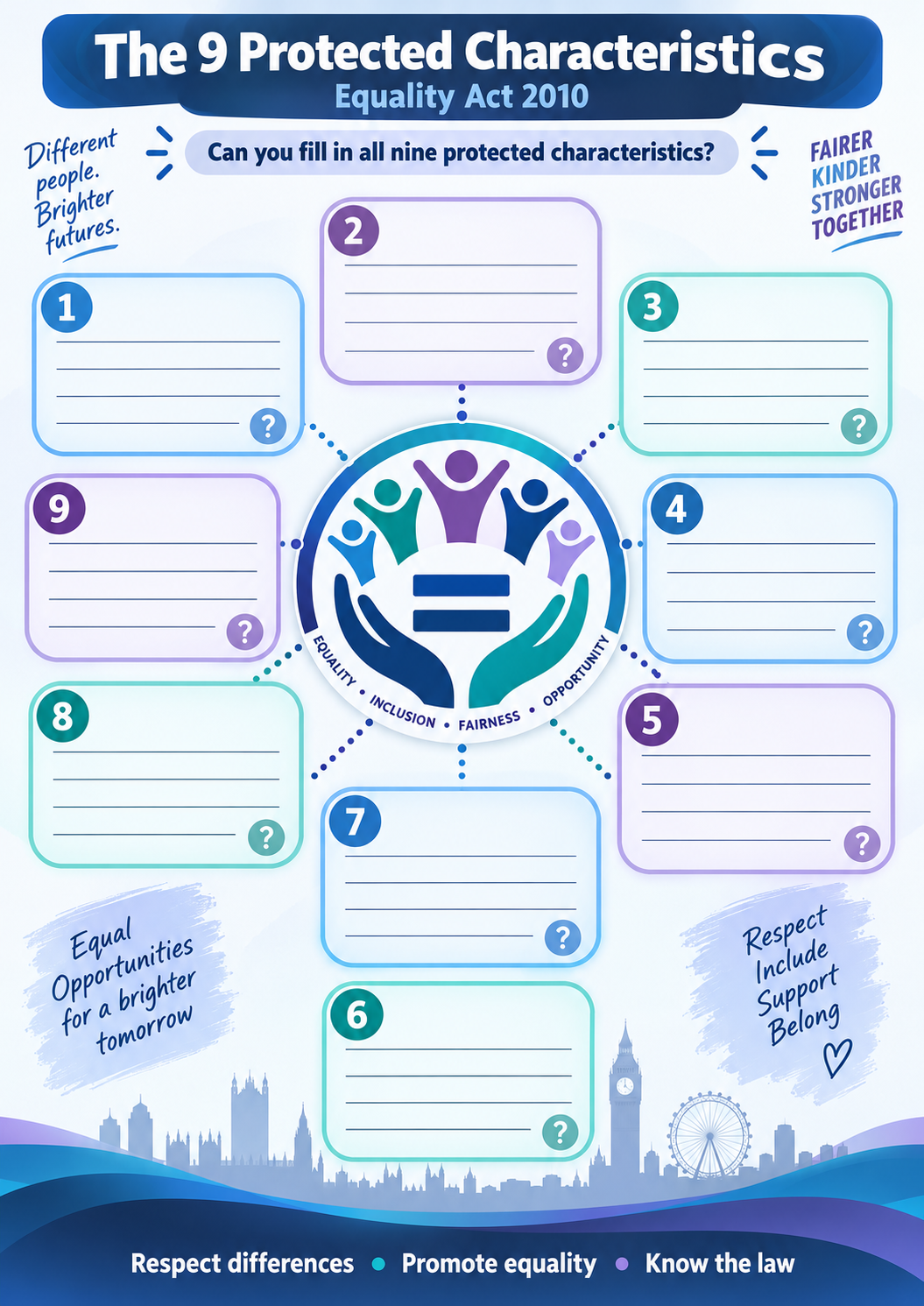
The Equality act of 2010 was bought about by the imalgimation of a number of anti-discrimination laws and legislations in 2010. The act identifies nine principles and chararcters that are protected, these are.
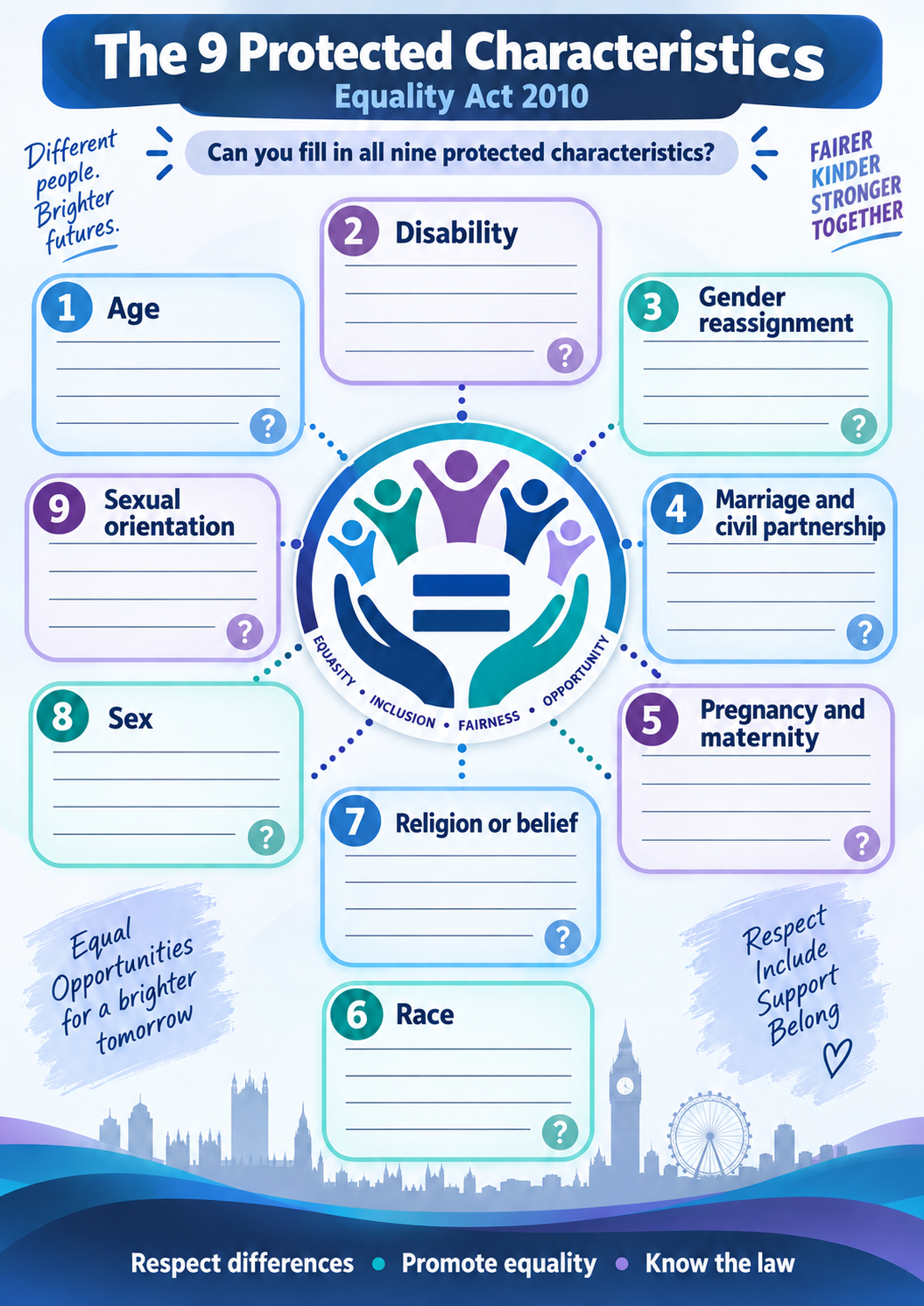
1. Age
Protection against discrimination based on a person’s age or age group (young or old) means that individuals must be treated fairly and equally regardless of how old they are, whether they are younger or older than the average person in a particular setting. Under UK equality legislation, it is unlawful to disadvantage someone simply because of assumptions, stereotypes, or generalisations linked to their age.
This protection applies across employment, education, training, and the provision of goods and services. Decisions such as recruitment, promotion, access to training, pay, redundancy selection, and dismissal must be based on ability, competence, experience, and performance, not age.
Age discrimination can take several forms:
-
Direct discrimination - treating someone less favourably because of their age (e.g. refusing to hire someone because they are “too young” or “too old”).
-
Indirect discrimination - applying policies that disadvantage a particular age group without a valid justification (e.g. requiring a set number of years’ experience that is unnecessary for the role).
-
Harassment - age-related jokes, comments, or behaviour that create an intimidating or offensive environment.
-
Victimisation - treating someone unfairly because they have complained about age discrimination or supported someone else’s complaint.
In practice, this means employers and organisations must:
-
Use age-neutral language in job advertisements and policies.
-
Offer equal access to training and development, regardless of age.
-
Avoid assumptions such as younger people being unreliable or older people being resistant to change.
-
Ensure performance management and redundancy decisions are objective and evidence-based.
Failure to uphold age protection can lead to employment tribunal claims, compensation awards, reputational damage, and loss of skilled or experienced individuals, all of which can negatively affect organisational performance and workplace culture.
In practice (compliant)
-
A company advertises roles using skills and experience, not age-related language.
-
Training opportunities are offered equally to apprentices, early-career staff, and older employees.
Not followed (non-compliant)
-
A job advert states “ideal for a young, energetic graduate”.
-
Older workers are excluded from training because they are “nearing retirement”.
Consequences for organisations
-
Employment tribunal claims
-
Compensation awards
-
Reputational damage and negative publicity
-
Loss of experienced staff
2. Disability
A physical or mental impairment that has a substantial and long-term negative effect on day-to-day activities refers to the legal definition of a disability under UK equality legislation. This protection ensures that individuals are not treated less favourably because of a disability and are supported to participate fully in work, education, and society.
A condition is considered a disability when:
-
Physical or mental - it may affect the body (e.g. mobility, sight, hearing) or mental health (e.g. anxiety disorders, depression).
-
Substantial - the effect is more than minor or trivial.
-
Long-term - the condition has lasted, or is expected to last, 12 months or more.
-
Day-to-day activities - it impacts normal activities such as walking, concentrating, reading, communicating, or using IT systems.
This protection covers both visible and non-visible (hidden) disabilities, including conditions such as dyslexia, autism, diabetes, epilepsy, and long-term mental health conditions.
Disability discrimination can occur in several ways:
-
Direct discrimination - treating someone unfairly because of their disability.
-
Indirect discrimination - applying policies that disadvantage disabled people (e.g. rigid working hours).
-
Discrimination arising from disability - treating someone unfairly because of something connected to their disability (e.g. disability-related absence).
-
Harassment and victimisation - creating a hostile environment or penalising someone for raising concerns.
In practice, organisations have a legal duty to make reasonable adjustments to remove barriers that disadvantage disabled individuals. This may include:
-
Providing specialist equipment or assistive technology.
-
Adjusting working hours or duties.
-
Offering alternative assessment or communication methods.
-
Making physical changes to buildings or workspaces.
Failure to support disabled individuals or make reasonable adjustments can result in employment tribunal claims, significant financial compensation, enforcement action by regulators, and serious reputational damage. Organisations that proactively support disability inclusion benefit from improved staff wellbeing, higher retention, and a more diverse and effective workforce.
In practice (compliant)
-
Providing reasonable adjustments, such as:
-
Screen readers for visually impaired staff
-
Flexible working hours
-
Modified duties or equipment
-
Not followed (non-compliant)
-
Refusing to adjust a workstation for an employee with chronic pain.
-
Dismissing performance issues without considering disability-related needs.
Consequences for organisations
-
Legal action for failure to make reasonable adjustments
-
Costly settlements
-
Enforcement action by the Equality and Human Rights Commission (EHRC)
3. Gender Reassignment
Protection for people who are transitioning, have transitioned, or identify as transgender means that individuals must not be discriminated against because of their gender reassignment status. Under UK equality legislation, a person is protected if they are proposing to undergo, are undergoing, or have undergone a process to reassign their sex, and this protection applies regardless of whether medical treatment or surgery is involved.
This protection recognises that gender reassignment is a deeply personal process and that individuals have the right to be treated with dignity, respect, and privacy in all areas of life, including employment, education, and access to services.
Discrimination related to gender reassignment can take several forms:
-
Direct discrimination - treating someone less favourably because they are transgender (e.g. refusing promotion due to their transition).
-
Indirect discrimination - policies or practices that disadvantage trans people without justification (e.g. inflexible dress codes).
-
Harassment - unwanted conduct such as jokes, intrusive questions, or deliberate misuse of names or pronouns.
-
Victimisation - treating someone unfairly because they have raised concerns or supported others regarding trans rights.
In practice, organisations are expected to:
-
Respect an individual’s chosen name, title, and pronouns.
-
Update records confidentially and accurately.
-
Ensure access to appropriate facilities, such as toilets or changing areas.
-
Maintain strict confidentiality about a person’s gender history.
Failure to uphold protections for transgender individuals can result in legal claims, compensation awards, and significant reputational damage. It can also lead to a toxic workplace culture, reduced staff wellbeing, and higher turnover. Organisations that actively support gender identity inclusion benefit from stronger trust, improved morale, and a more inclusive and respectful environment for all.
In practice (compliant)
-
Respecting chosen names and pronouns.
-
Updating HR records confidentially and appropriately.
-
Allowing access to correct toilets and facilities.
Not followed (non-compliant)
-
Deliberate misgendering by managers.
-
Excluding a trans employee from customer-facing roles.
Consequences for organisations
-
Discrimination and harassment claims
-
Severe reputational harm
-
Loss of trust among staff and customers
4. Marriage and Civil Partnership
Protection for people who are married or in a civil partnership (employment-related only) means that employees and job applicants must not be treated less favourably because they are legally married or in a civil partnership. Under UK equality legislation, this protection applies specifically within employment and workplace contexts, such as recruitment, promotion, pay, training, and dismissal.
This characteristic recognises that an individual’s legal relationship status should have no bearing on their ability to perform a role or access workplace opportunities. It applies equally to opposite-sex marriages and same-sex civil partnerships.
Discrimination related to marriage or civil partnership may include:
-
Direct discrimination - treating someone unfairly because they are married or in a civil partnership (e.g. overlooking them for promotion due to assumptions about family commitments).
-
Indirect discrimination - applying workplace policies that disadvantage married or civil-partnered employees without objective justification.
-
Victimisation - treating someone unfavourably because they have raised concerns or supported a complaint related to this protection.
In practice, employers must:
-
Ensure recruitment and promotion decisions are based on merit, skills, and performance, not marital status.
-
Provide equal access to workplace benefits, training, and development opportunities.
-
Avoid assumptions that married employees are less flexible or more distracted by personal responsibilities.
-
Treat civil partnerships with the same respect and recognition as marriage.
Failure to comply with this protection can result in employment tribunal claims, financial compensation, and damage to organisational reputation. It can also negatively affect staff morale and trust. Organisations that apply fair and inclusive practices create a more respectful working environment and benefit from higher employee engagement and retention.
In practice (compliant)
-
Equal access to benefits, promotions, and training regardless of marital status.
Not followed (non-compliant)
-
Assuming married employees are less flexible.
-
Denying opportunities to staff in civil partnerships.
Consequences for organisations
-
Tribunal claims
-
Breach of employment law
-
Damage to workplace morale
5. Pregnancy and Maternity
Protection during pregnancy and maternity leave means that individuals must not be treated unfairly because they are pregnant, have recently given birth, or are on maternity leave. Under UK equality legislation, pregnancy and maternity is a protected characteristic that ensures individuals are supported during this period and are able to return to work without disadvantage.
This protection applies from the start of pregnancy through to the end of statutory maternity leave and covers all aspects of employment, including recruitment, pay, promotion, training, redundancy, and dismissal.
Discrimination related to pregnancy and maternity can include:
-
Direct discrimination - treating someone less favourably because they are pregnant or on maternity leave (e.g. refusing promotion or dismissing them due to pregnancy).
-
Unfair dismissal - terminating employment for reasons connected to pregnancy or maternity.
-
Detriment - placing someone at a disadvantage, such as removing responsibilities or excluding them from opportunities.
In practice, employers are required to:
-
Carry out pregnancy risk assessments to protect health and safety.
-
Allow time off for antenatal appointments.
-
Provide statutory maternity leave and pay in line with the law.
-
Ensure employees can return to the same job, or a suitable alternative, after maternity leave.
-
Support flexible working requests where appropriate.
Failure to uphold pregnancy and maternity protections can lead to automatic unfair dismissal claims, significant financial compensation, and serious reputational damage. It can also undermine workplace trust and staff wellbeing. Organisations that actively support pregnant employees and new parents benefit from higher staff retention, improved morale, and a positive organisational culture.
In practice (compliant)
-
Conducting pregnancy risk assessments.
-
Allowing maternity leave and flexible return-to-work arrangements.
Not followed (non-compliant)
-
Dismissing an employee due to pregnancy.
-
Penalising absence related to maternity.
Consequences for organisations
-
Automatic unfair dismissal claims
-
High compensation payouts
-
Regulatory scrutiny
6. Race
Includes colour, nationality, ethnic or national origin refers to the protected characteristic of race under UK equality legislation. This protection ensures that individuals are not discriminated against, harassed, or victimised because of their racial background or heritage, and that everyone is treated fairly and with respect.
Race protection covers a wide range of characteristics, including:
-
Colour - skin colour or complexion.
-
Nationality - citizenship or legal national status.
-
Ethnic origin - shared cultural traditions, language, or ancestry.
-
National origin - country or region where a person was born or has family roots.
This protection applies across employment, education, housing, healthcare, and access to goods and services.
Race discrimination can take several forms:
-
Direct discrimination - treating someone less favourably because of their race (e.g. refusing to hire someone due to their accent or skin colour).
-
Indirect discrimination - policies that disadvantage certain racial groups without objective justification (e.g. recruitment practices that favour only local qualifications when equivalents exist).
-
Harassment - racist language, jokes, stereotyping, or exclusion.
-
Victimisation - penalising someone for reporting or supporting a complaint about racial discrimination.
In practice, organisations are expected to:
-
Implement fair and transparent recruitment and promotion processes.
-
Provide equality and diversity training to staff.
-
Challenge racist behaviour immediately and effectively.
-
Monitor policies and outcomes to identify and address racial inequality.
Failure to comply with race protection can result in serious legal consequences, including employment tribunal claims, large compensation awards, and intervention by regulatory bodies. It can also cause significant reputational damage, loss of public confidence, and reduced staff morale. Organisations that actively promote racial equality benefit from a more inclusive culture, improved decision-making, and stronger relationships with employees and service users.
In practice (compliant)
-
Fair recruitment processes with anonymised applications.
-
Zero-tolerance policies for racist language or behaviour.
Not followed (non-compliant)
-
Racial harassment ignored by management.
-
Promotion decisions influenced by ethnicity.
Consequences for organisations
-
Serious reputational damage
-
Legal penalties and compensation
-
Loss of public contracts or funding
7. Religion or Belief
Includes religious beliefs, philosophical beliefs, or lack of belief refers to the protected characteristic of religion or belief under UK equality legislation. This protection ensures that individuals are not treated unfairly because of what they believe, how they practise their beliefs, or because they do not hold any religious or philosophical belief.
This protection covers:
-
Religious beliefs - such as Christianity, Islam, Hinduism, Judaism, Sikhism, Buddhism, and other recognised religions.
-
Philosophical beliefs - beliefs that are genuinely held, serious, and affect how a person lives their life (e.g. ethical veganism).
-
Lack of belief - protection for people who do not follow a religion or belief system.
Religion or belief discrimination can take several forms:
-
Direct discrimination - treating someone less favourably because of their religion or belief (e.g. refusing employment because of religious dress).
-
Indirect discrimination - policies that disadvantage people of certain beliefs without justification (e.g. mandatory work times that conflict with religious observance).
-
Harassment - offensive comments, jokes, or behaviour relating to religion or belief.
-
Victimisation - treating someone unfairly because they have raised or supported a complaint.
In practice, organisations should:
-
Accommodate reasonable requests related to religious observance, such as prayer breaks or flexible working hours.
-
Allow religious dress or symbols unless there is a genuine and proportionate reason (such as health and safety).
-
Foster a culture of mutual respect and understanding.
-
Ensure policies are inclusive and do not disadvantage particular belief groups.
Failure to respect religion or belief protections can lead to employment tribunal claims, financial compensation, and reputational harm. It may also create a divisive or hostile environment, reducing staff engagement and wellbeing. Organisations that actively respect religious diversity benefit from a more inclusive workplace and stronger relationships with employees and service users.
In practice (compliant)
-
Allowing prayer space or flexible breaks.
-
Respecting religious dress unless a genuine safety reason exists.
Not followed (non-compliant)
-
Mocking religious practices.
-
Refusing reasonable requests for religious observance.
Consequences for organisations
-
Discrimination and harassment claims
-
Loss of workforce diversity
-
Negative press coverage
8. Sex
Protection against discrimination based on being male or female refers to the protected characteristic of sex under UK equality legislation. This protection ensures that individuals are treated fairly and equally regardless of whether they are male or female, and that decisions are based on ability, merit, and performance rather than gender-based assumptions or stereotypes.
This protection applies across employment, education, training, and the provision of goods and services.
Sex discrimination can take several forms:
-
Direct discrimination - treating someone less favourably because of their sex (e.g. refusing promotion because someone is female or male).
-
Indirect discrimination - policies or practices that disadvantage one sex more than the other without objective justification (e.g. work patterns that disproportionately affect women).
-
Harassment - unwanted behaviour related to sex that violates dignity or creates a hostile or offensive environment.
-
Victimisation - treating someone unfairly because they have raised or supported a complaint about sex discrimination.
In practice, organisations must:
-
Ensure equal pay for equal work, in line with equal pay legislation.
-
Provide fair access to recruitment, promotion, training, and development opportunities.
-
Prevent and address sexual harassment through clear policies and training.
-
Avoid gender stereotypes, such as assumptions about leadership ability or technical competence.
Failure to comply with sex discrimination protections can result in employment tribunal claims, equal pay disputes, substantial financial penalties, and serious reputational damage. It can also negatively affect organisational culture, leading to reduced morale and trust. Organisations that promote gender equality benefit from improved staff engagement, better decision-making, and a more inclusive and productive workplace.
In practice (compliant)
-
Equal pay for equal work.
-
Fair promotion and development opportunities.
Not followed (non-compliant)
-
Gender pay inequality.
-
Excluding women from senior roles or technical teams.
Consequences for organisations
-
Gender pay gap reporting failures
-
Tribunal claims
-
Loss of public trust and brand credibility
9. Sexual Orientation
Protection for lesbian, gay, bisexual, and heterosexual individuals refers to the protected characteristic of sexual orientation under UK equality legislation. This protection ensures that individuals are not treated unfairly, harassed, or excluded because of who they are attracted to, who they form relationships with, or how they identify their sexual orientation.
Sexual orientation protection applies equally to:
-
Lesbian individuals
-
Gay individuals
-
Bisexual individuals
-
Heterosexual individuals
It covers all stages of employment and service provision, including recruitment, promotion, training, dismissal, education, and access to goods and services.
Discrimination related to sexual orientation can take several forms:
-
Direct discrimination - treating someone less favourably because of their sexual orientation (e.g. refusing promotion because someone is gay).
-
Indirect discrimination - policies that disadvantage people of a particular sexual orientation without justification.
-
Harassment – homophobic, biphobic, or derogatory language, jokes, or behaviour.
-
Victimisation - treating someone unfairly because they have reported discrimination or supported another complaint.
In practice, organisations are expected to:
-
Maintain inclusive policies that clearly prohibit discrimination and harassment.
-
Challenge inappropriate language or behaviour immediately.
-
Ensure equal access to benefits, training, and career progression.
-
Create an environment where individuals feel safe to be open about their identity without fear of negative consequences.
Failure to uphold sexual orientation protections can result in employment tribunal claims, financial compensation, and serious reputational damage. It can also lead to a hostile workplace culture, reduced staff wellbeing, and higher staff turnover. Organisations that actively promote inclusionand equality benefit from increased trust, stronger teamwork, and a more positive organisational reputation.
In practice (compliant)
-
Inclusive policies and staff training.
-
Challenging homophobic language immediately.
Not followed (non-compliant)
-
Harassment ignored or dismissed as “banter”.
-
Denying promotion due to sexual orientation.
Consequences for organisations
-
Legal claims and compensation
-
Workplace culture breakdown
-
High staff turnover
Further guidance is provided to organisations through a number of governmental webpages.
The Equality Act and protected characteristics | Local Government Association
Equality in the Workplace – Protected Characteristics Presentation
You will focus on one of the protected characteristics covered by the Equality Act 2010 and explain how it must be protected at work.
How You Will Work
You will work in a small team of 2–3 students
Each team will be given one protected characteristic
No two teams will work on the same characteristic
You will create and deliver a short presentation (5–7 minutes)
The 9 Protected Characteristics
Your teacher will assign your group one of the following:
- Age
- Disability
- Gender reassignment
- Marriage and civil partnership
- Pregnancy and maternity
- Race
- Religion or belief
- Sex
- Sexual orientation
What Your Presentation MUST Include
Your presentation must contain all of the sections below. Missing sections may mean you do not meet the learning outcome.
1. Explain the Protected Characteristic
You must:
- Clearly explain what your assigned protected characteristic means
- Describe how it applies in a workplace setting
- Give at least one example (e.g. recruitment, promotion, training, working conditions)
2. Explain Employer Responsibilities
You must explain:
- What employers are legally required to do to protect this characteristic
- How employers should treat staff fairly
- Any adjustments or policies employers must have in place
Examples may include:
- Equality and diversity policies
- Fair recruitment practices
- Reasonable adjustments for staff
3. Case Study of Failure
You must include a real or realistic case study where an employer failed to meet their legal responsibilities.
You must explain:
- What the employer did wrong
- Which protected characteristic was affected
- How this affected the employee or individual
- What happened to the employer as a result
4. Consequences for Employers
You must explain what can happen if an employer does not follow equality legislation, such as:
- Legal action or employment tribunals
- Financial penalties
- Damage to reputation
- Loss of staff trust and morale
5. How Employers Can Do Better
You must suggest practical ways employers can prevent discrimination, for example:
- Staff training
- Clear reporting procedures
- Fair workplace policies
- Inclusive working practices
Presentation Rules
Every group member must speak
Use clear and professional language
Slides should support what you say, not be full of text
Include at least one image, diagram, or visual
Types of discrimination:
Direct Discrimination
Definition
Direct discrimination occurs when someone is treated less favourably than another person because of a protected characteristic (such as age, disability, gender reassignment, race, religion, sex, or sexual orientation).
This type of discrimination is intentional and often easy to identify because the unfair treatment is clearly linked to who the person is.
Workplace Example
An employer refuses to promote a qualified female employee because they believe “men are better suited to leadership roles”.
Case Study: Pregnancy Discrimination
A UK tribunal case involved a woman being dismissed shortly after informing her employer she was pregnant. Her employer claimed the dismissal was due to “performance issues”, but evidence showed her performance had been rated positively before the pregnancy announcement.
Indirect Discrimination
Definition
Indirect discrimination happens when a policy, rule, or working practice applies to everyone but disadvantages a particular group with a protected characteristic.
Importantly, this discrimination is often unintentional.
Workplace Example
A company introduces a rule that all staff must work late on Friday evenings. This disadvantages Muslim employees who attend Friday prayers.
Case Study: Working Hours Policy
In a UK case, a retail employer required all managers to work full-time hours, including weekends. A female employee returning from maternity leave requested flexible working, which was refused.
Harassment
Definition
Harassment is unwanted behaviour related to a protected characteristic that violates someone’s dignity or creates an intimidating, hostile, degrading, humiliating, or offensive environment.
It can be:
-
Verbal (comments, jokes)
-
Physical
-
Written or digital (emails, messages)
Workplace Example
An employee repeatedly makes jokes about a colleague’s disability, despite being asked to stop.
Case Study: Racial Harassment at Work
In a UK tribunal case, an employee was subjected to repeated racial slurs and “banter” by colleagues. Management failed to take action when complaints were raised.
Victimisation
Definition
Victimisation occurs when someone is treated unfairly because they have made, supported, or are believed to have made a complaint about discrimination or harassment.
This includes:
-
Being disciplined
-
Being denied promotion
-
Being excluded or dismissed
Workplace Example
An employee raises a formal grievance about racial discrimination and is later excluded from training opportunities as a result.
Case Study: Retaliation After Complaint
In a UK case, an employee who supported a colleague’s discrimination claim was later passed over for promotion and given negative appraisals.
Create an infographic on the different types of descrimination that occur, Provide examples of where this has happened and the consiquences to orgnisations and individuals. Your inforgraphic should be as informative as is possible including images that capture the attention of others.
• where individuals are protected
• when to take action against discrimination
o time limits for claims.
4.1.6 Understand Intellectual Property legislation:
"Its all Mine, or is it?
Create a infomative presentation to discuss and explain the priniples of Interlectual Property or IP. Discuss, what it protects, who it protects, the ownership of it. Explain the protection that is given and what protection areas that there are. Where you are able to provide examples of breaches, or agreements with employees and organisations that have happened.
• unregistered designs
• registered designs
• patents.
US vs China over IP
“Who Owns It?”
Learning focus: Understanding Intellectual Property, ownership, and misuse in the UK
Scenario (Read this first)
You work for a small digital company that creates:
- Websites
- Apps
- Logos
- Training videos
- Social media content
Your manager has discovered that some content may have been copied, reused, or shared incorrectly.
Your job is to decide who owns the work, what type of Intellectual Property applies, and whether the use is legal or illegal.
Task 1 - IP Decision Cards (8 minutes)
Your teacher will give you (or display) 4 short scenarios.
For each scenario, discuss and decide:
- What type of Intellectual Property is involved?
- Copyright
- Trademark
- Patent
- Design right
- Is this use allowed or not?
- Allowed
- Not allowed
- Why? (Give one clear reason)
Example Scenarios
Scenario A
A student copies code from GitHub and submits it as their own coursework.
Scenario B
A business uses a competitor’s logo on their website “by mistake”.
Scenario C
A developer creates a new mobile app using an original idea and original code.
Scenario D
Someone downloads an image from Google and uses it on a business website without permission.
Task 2 - Quick Share & Challenge (3 minutes)
Each group:
Chooses one scenario
Explains their decision in 30 seconds
Other groups can:
Agree
Challenge the decision
Ask “What law protects that?”
Task 3 - Rapid-Fire Quiz (2 minutes)
Quick questions.
Put thumbs up for legal or thumbs down for illegal.
Examples:
“Using music in a YouTube video without permission”
“Creating your own logo for a new brand”
“Sharing paid software with friends”
What You Should Now Understand by the end of this activity, you should be able to:
Explain what Intellectual Property is
Identify different types of IP
Recognise legal vs illegal use
Understand why IP law exists in the UK
Apply IP rules to real digital and workplace scenarios
Stretch (If Time Allows)
Answer this question verbally or in writing:
Why is Intellectual Property especially important in digital industries like IT, media, and software development?
4.1.7 Understand Electrical Waste legislation:

The WEEE regulations are a set of environmental regulations that are designed to ensure that any electrical equipment is recycled, reused, or disposed of in an ethical and non-environmentally impacting way. Within companies, any electrical material or devices are in most situations, disposed of in specialist bins that external contractors will take away and do the recycling of the materials if they cannot be reused again, however, in some situations, some of the electrical devices may need to be destroyed beyond any repair or reuse as these may store personal and sensitive information, and must be disposed of destructively.
WEEE legislation is necessary because electrical equipment contains toxic materials, such as lead and mercury, which can cause environmental damage if disposed of incorrectly. In addition, most IT equipment stores personal or organisational data, meaning unsafe disposal can lead to data breaches and security incidents. Under WEEE, organisations are required to use authorised disposal routes and ensure equipment is recycled or treated safely.
Consider what mineral resources are used in most electronic devices, how are these found/collected/created? what environmental impact does the gathering of these resources have on the globe?
The following video shows, the poppular TV show Gold Rush and the efforts of miners to get as much gold as they can mine. Reflect on the images in the video and the equipment that is used and the materials that these use to get to the gold. Now we should think, what electronics we have in our cupboards and draws that we no longer use. What would be done with these?
In small groups of 2-3 reflect on the disposal of electrical equipment, research and discuss the main minerals found in most electrical devices and the current issue of e-waste in the UK.
o key features:
governs the safe and environmentally responsible disposal of electrical equipment
What the Legislation says
Review and discuss with others the WEEE legislation that is applied in the UK. Using the following link explore the principles, what organisations can do to ensure that they meet these expectations and obide by the prinicples in thier practices
Regulations: Waste Electrical and Electronic Equipment (WEEE) GOV.UK
Waste Electrical and Electronic Equipment Regulations
A medium-sized UK financial services company undertook a routine IT refresh, replacing over 120 desktop PCs, laptops, and network switches. Due to time pressure and a lack of clear internal procedures, the organisation instructed facilities staff to remove the old equipment. The devices were collected by a general waste contractor, not a licensed WEEE disposal provider.
Several of the machines still contained hard drives with customer data, including names, addresses, and partial financial records.
What Went Wrong
The organisation failed in several key areas:
WEEE non-compliance: Electrical equipment was not disposed of through an authorised WEEE scheme
Poor data handling: Hard drives were not wiped, removed, or destroyed
Lack of staff training: Facilities staff were unaware of legal responsibilities
No audit trail: There was no waste transfer documentation
Weeks later, some of the equipment was discovered at an unregulated recycling site, with data still accessible on the drives.
What Should Have Happened
If WEEE legislation and safe disposal procedures had been followed:
All devices would have been logged as end-of-life assets
Storage media would have been:
Securely wiped using certified software
Or physically destroyed (e.g. shredding)
Equipment would have been collected by a licensed WEEE contractor
Disposal would be documented using waste transfer notes
Staff roles and responsibilities would be clearly defined
Safe disposal
Environmentally responsible disposal.
Environmentally responsible disposal is the process of getting rid of waste, particularly electrical and electronic equipment (WEEE), in a way that minimises harm to the environment and protects human health while fully complying with UK environmental legislation. Electrical equipment often contains hazardous substances such as heavy metals and chemicals, which can cause serious environmental damage if released into soil or water. Environmentally responsible disposal ensures these materials are handled safely and prevents pollution and long-term ecological harm.
Rather than disposing of electrical items in landfill, environmentally responsible disposal focuses on reuse, recycling, and safe treatment of waste through approved methods. Equipment that is still functional may be refurbished and reused, extending its lifespan and reducing the demand for new raw materials. Where reuse is not possible, devices are dismantled so that valuable materials such as copper, aluminium, and plastics can be recovered and recycled. Any hazardous components are removed and treated in specialist facilities.
This process is carried out by licensed and authorised waste contractors who follow strict regulations and provide documentation such as waste transfer notes to demonstrate compliance. By using approved disposal routes, organisations reduce their legal risk, support sustainability objectives, and demonstrate ethical and professional practice. Overall, environmentally responsible disposal plays a vital role in protecting the environment, supporting the circular economy, and ensuring organisations meet their legal and social responsibilities.
UK Organisations That Provide Environmentally Responsible Disposal
Veolia
Veolia is one of the UK’s largest waste management companies and provides WEEE-compliant recycling services for businesses and public sector organisations.
Services include:
-
Collection and recycling of IT equipment
-
Separation of hazardous materials
-
Resource recovery and reuse
Biffa
Biffa offers environmentally responsible WEEE disposal and works closely with organisations to reduce landfill waste.
Services include:
-
WEEE recycling collections
-
Environmental compliance reporting
-
Sustainable waste management solutions
Recycling Lives
Recycling Lives focuses on ethical recycling and reuse, particularly for IT and electronic equipment.
Services include:
-
IT refurbishment and reuse
-
Responsible recycling of non-reusable equipment
-
Strong environmental and social responsibility focus
Computer Disposals Ltd
A specialist IT asset disposal (ITAD) provider that combines secure data destruction with environmentally responsible recycling.
Services include:
-
Secure hard drive destruction
-
WEEE-compliant recycling
-
Certification and audit trails
Benefits of Using Environmentally Responsible Disposal Organisations
Environmental benefits
Reduces landfill waste and pollution
Prevents release of hazardous substances
Supports recycling and circular economy principles
Legal and compliance benefits
Ensures compliance with WEEE Regulations
Provides waste transfer notes and audit evidence
Reduces risk of fines or enforcement action
Professional and reputational benefits
Demonstrates corporate social responsibility
Builds trust with customers and stakeholders
Supports sustainability policies and ESG targets
Operational benefits
Clear processes and expert handling
Reduced burden on internal staff
Professional handling of hazardous materials
Drawbacks of Using Specialist Disposal Organisations
Cost
Specialist WEEE and IT disposal services can be more expensive than general waste collection
Secure data destruction often carries additional charges
Administrative overhead
Requires contracts, scheduling, and record-keeping
May involve audits or compliance checks
Logistics
Collection times may need to be booked in advance
Organisations may need secure storage for equipment before collection
Limited control
Disposal is handled externally, meaning organisations must trust third-party providers
Due diligence is required to ensure contractors are genuinely compliant
Although environmentally responsible disposal organisations can involve higher costs and increased administration, these drawbacks are outweighed by the legal protection, environmental benefits, and reduced security risk they provide. Using licensed WEEE providers ensures compliance with legislation, protects sensitive data, and supports sustainability objectives.
For organisations handling IT equipment, environmentally responsible disposal should be viewed not as an optional expense, but as a necessary part of professional and ethical practice.
To Dispose or not Dispose That is the question
Using the following worksheet, and working pairs work through the tasks and questions, you will reflect back to the group on your findings and suggestions.
WEEE worksheet
4.1.8 Understand the interrelationships between digital support and security and digital legislation, and make judgements about the impact on organisations, society and individuals.
4.1.9 Know that international law applies to some offences:
International law can affect how offences are investigated, prosecuted and regulated within the United Kingdom, particularly where criminal activity crosses national borders. However, it is important to recognise that the UK operates a dual legal system. This means that an international treaty does not normally become directly enforceable in UK courts simply because the UK has agreed to it. Parliament may need to introduce or amend domestic legislation to give the treaty effect within UK law. However International law still has considerable influence.
Treaties can require countries to criminalise particular behaviour, cooperate with foreign investigators, exchange evidence or extradite suspects. UK legislation can also give courts extraterritorial jurisdiction, which allows certain offences committed partly or wholly outside the UK to be prosecuted where there is a sufficient connection with the UK. For example, under the Computer Misuse Act 1990, an offence may fall within the jurisdiction of England and Wales where there is a significant domestic link, such as the offender being in the country, the targeted computer being located here, or serious damage occurring here. This is increasingly important because cybercrime, terrorism, fraud, organised crime and surveillance activities frequently involve people, computer systems and evidence located in several different countries.
A practical example can be seen in international action against the HIVE ransomware group. HIVE attacked more than 1,300 victims internationally, including approximately 50 organisations in the UK. The National Crime Agency worked alongside authorities in the United States, Canada and numerous European countries to disrupt the group's infrastructure. Although offenders would ultimately be prosecuted using the relevant domestic criminal laws of the country bringing the prosecution, international agreements and law-enforcement cooperation make it possible for countries to share intelligence and evidence and coordinate investigations against offenders operating across borders
International Law in Cyberspace
Cyberspace creates particular difficulties for traditional legal systems because an action carried out from one country can affect computers, organisations and individuals located thousands of miles away. A cyberattack could, for example, be launched by an offender in one country, use servers in several other countries and ultimately attack an organisation located in the UK.
The UK government's position is that cyberspace is not separate from international law. Existing international law applies to the activities of states in cyberspace in broadly the same way as it applies to their activities in the physical world.
The UN Charter and cyberattacks
The United Nations Charter applies to the behaviour of states in cyberspace. This becomes particularly important when cyber activity is conducted or supported by a government rather than an individual criminal.
For example, Article 2(4) of the UN Charter prohibits states from unlawfully using force against another state. The UK considers that an extremely serious cyberattack could potentially amount to a use of force where its scale and consequences were comparable with those produced by conventional physical action.
An example could be a state-sponsored cyberattack which:
-
seriously damaged another country's electricity network;
-
disabled important healthcare infrastructure;
-
caused significant physical destruction;
-
disrupted essential financial infrastructure; or
-
resulted in injury or loss of life.
At the most serious level, the UK considers that a cyber operation could constitute an armed attack, potentially allowing the affected country to exercise its right of self-defence under Article 51 of the UN Charter.
International cybercrime
There is also a distinction between state cyber operations and ordinary cybercrime.
A criminal hacker attempting to access a UK company's network would normally be dealt with through criminal legislation such as the Computer Misuse Act 1990, rather than being prosecuted directly under the UN Charter or another rule governing relationships between states.
The international element becomes important when the offender, victim, servers or evidence are located in different countries.
One important international agreement is the Council of Europe Convention on Cybercrime, commonly known as the Budapest Convention. It entered into force for the UK on 1 September 2011.
The Convention provides a common international framework for tackling computer-related crime and facilitates cooperation between participating countries. This can assist authorities with matters such as:
-
obtaining electronic evidence;
-
preserving computer data;
-
sharing information between law-enforcement organisations;
-
responding quickly to cybercrime investigations;
-
cooperating where offenders and victims are in different countries; and
-
developing compatible approaches to computer-related offences.
The Council of Europe describes the Convention as both a legal framework and a mechanism allowing investigators in participating countries to cooperate in specific cases, including emergencies.
International Law and Surveillance
International law is also important when governments use surveillance to investigate crime, terrorism or threats to national security.
Within the UK, surveillance powers are principally controlled through domestic legislation including the Investigatory Powers Act 2016 and, for some types of covert activity, the Regulation of Investigatory Powers Act 2000 (RIPA). These laws regulate activities such as interception of communications, obtaining communications data, equipment interference and covert surveillance.
However, UK surveillance activities are also affected by international human-rights obligations.
European Convention on Human Rights
One of the most important examples is the European Convention on Human Rights (ECHR).
Article 8 of the Convention protects the:
right to respect for private and family life, home and correspondence.
This protection extends to areas such as telephone interception and the collection of private information by government security services.
Surveillance is not automatically prohibited by Article 8. Governments may conduct surveillance for legitimate purposes such as:
-
national security;
-
public safety;
-
preventing crime;
-
investigating serious crime; and
-
protecting the rights of others.
However, surveillance must operate within an appropriate legal framework. It must have a legitimate purpose and must be necessary and proportionate rather than allowing unrestricted monitoring of individuals.
For example, investigating a suspected terrorist organisation may justify highly intrusive surveillance where the legal requirements have been satisfied. Conducting the same level of surveillance against thousands of people without adequate justification or safeguards would be considerably more difficult to justify.
A significant practical example of international law affecting UK surveillance is Big Brother Watch and Others v United Kingdom.
The case concerned aspects of the UK's previous surveillance regime, including bulk interception of communications and the acquisition of communications data.
In its final Grand Chamber judgment of 25 May 2021, the European Court of Human Rights found shortcomings in the UK's former bulk interception system. These included inadequate independent authorisation and insufficient safeguards surrounding the selection and examination of intercepted information. The Court found violations of Article 8, concerning privacy, and in certain respects Article 10, concerning freedom of expression and protection of journalistic material.
Importantly, the Court did not rule that bulk surveillance itself was always unlawful. Instead, surveillance of this kind requires sufficiently strong safeguards to reduce the risk of arbitrary or unjustified interference with people's privacy.
The case demonstrates how an international agreement can have a practical effect on the way surveillance operates within the UK.
Following changes to the UK's legal framework, including the Investigatory Powers Act 2016 and subsequent amendments, the Council of Europe stated that the UK's surveillance regime had been adjusted to Convention standards. It noted, among other safeguards, the UK's "double lock" approach, under which certain warrants require authorisation by a Secretary of State and approval by a senior judge. In December 2024, the Council of Europe's Committee of Ministers ended its supervision of the UK's implementation of the Big Brother Watch judgments.
International intelligence sharing
Surveillance becomes even more complicated when intelligence is shared internationally.
For example:
UK intelligence agency - foreign intelligence partner - intercepted communications
or
Foreign intelligence agency - UK intelligence agency - information concerning a UK suspect
International cooperation can be extremely important when investigating terrorism, cybercrime and organised crime because suspects may communicate across several countries.
However, governments should not simply use another country as a means of avoiding legal safeguards that would apply if they collected the information themselves.
Interestingly, in Big Brother Watch, the European Court of Human Rights found that the arrangements governing the UK's receipt of intelligence from foreign intelligence services contained sufficient safeguards against abuse.
This highlights the balance that international surveillance law attempts to achieve:
- Security and crime prevention
- Must be balanced against
- Privacy, freedom of expression and protection from unjustified state surveillance.
Last Updated
2026-09-18 12:36:07
English and Maths
English
Maths
Stretch and Challenge
Stretch and Challenge
Homework
Homework
Equality and Diversity Calendar
How to's
How to's Coverage
Links to Learning Outcomes |
Links to Assessment Criteria |
|
|---|---|---|
Files that support this week
→
Next ←
Prev