Top
Week 1
Task 1 Planning a Project
Activities
Marking
Indicative content
Gantt chart:
What is a Gantt Chartt, why we need them, and, how to lay them out
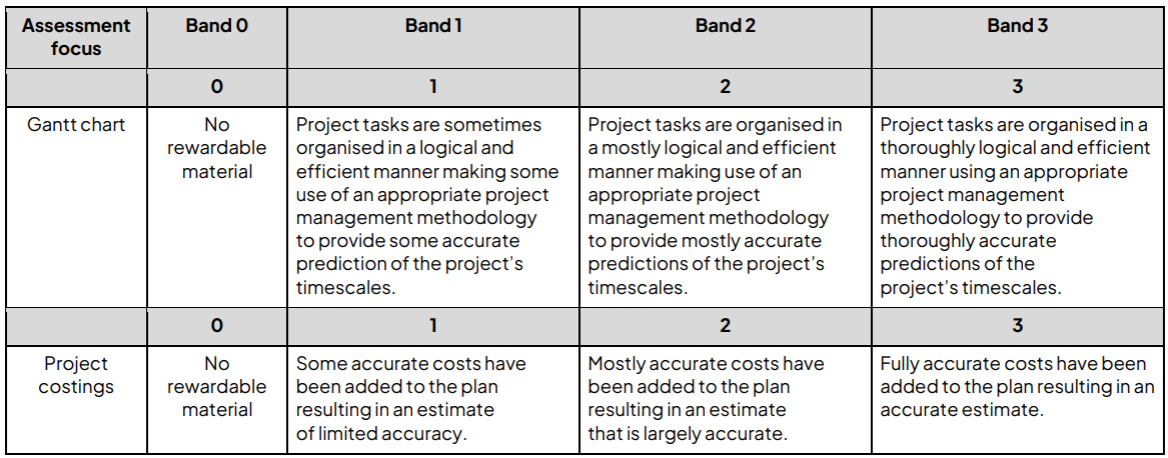
A Gantt chart is a structured project planning tool used to visually represent the scheduling, sequencing, and management of tasks over a defined period of time. It enables project managers to break a complex project into smaller, manageable activities and plot these against a timeline, showing start dates, durations, overlaps, dependencies, and resource allocation. In the Pearson Digital Support and Security T-Level Employer Set Project (ESP), learners are required to produce a Gantt chart as part of Task 1 - Planning a project, demonstrating their ability to prioritise tasks, assign appropriate staff based on skillset, and organise work using an effective project management methodology . A high-quality Gantt chart not only shows what needs to be done, but also reflects real=world IT deployment practices, such as staged testing, iterative fixing, and efficient use of personnel.
Gantt charts are used because they:
- Provide clarity and structure - breaking a complex IT project (e.g. network deployment) into clear, manageable stages
- Enable efficient time management – helping ensure deadlines are achievable through parallel tasking rather than linear workflows
- Support decision-making - allowing planners to identify bottlenecks, dependencies, and risks before work begins
- Improve resource allocation - ensuring staff (e.g. Senior Engineer vs Junior Engineer) are used effectively based on their skills
How to lay them out example
Task Identification, tasks should reflect realistic IT project stages seen in the ESP scenario these include, Infrastructure Installation,Server Installation and Configuration, Network Configuration, End-User Device Deployment, Testing and Validation (Spread Throughout), Fault Fixing and Optimisation, and, Final Configuration and Handover.
Phase 1: Infrastructure Installation
- Conduct site survey of both office locations this could include the following tasks
- Identify network points, power availability, and physical constraints
- Assess environmental risks (heat, access control, physical security)
- Install physical network cabling:
- Run Ethernet cables (Cat6/Cat6a) through trunking
- Label cables for identification and maintenance
- Install networking hardware:
- Mount switches and routers in racks
- Connect patch panels to switches
- Configure basic connectivity:
- Assign temporary IP addresses for testing
- Ensure devices are physically connected correctly
Concurrency opportunity: Infrastructure installation can occur simultaneously in multiple office locations
Phase 2: Server Installation and Configuration
- Install server hardware:
- Rack and power the server
- Connect to network infrastructure
- Install operating system:
- Configure RAID (if applicable)
- Install Windows Server/Linux
- Configure core services:
- Active Directory (user authentication)
- DNS (domain name resolution)
- DHCP (automatic IP allocation)
- Apply security configurations:
- Firewall rules
- Admin account restrictions
- Patch updates
Dependency: Cannot begin until infrastructure is installed and stable
Phase 3: Network Configuration
- Assign IP addressing scheme:
- Define subnets (e.g. separate staff and guest networks)
- Configure routing:
- Set default gateways
- Configure VLANs if required
- Configure wireless access:
- Set SSIDs
- Apply WPA3 security
- Test connectivity:
- Ping between devices
- Use traceroute to verify routing paths
Important examiner link: Testing should begin here - not left until the end
Phase 4: End-User Device Deployment
- Build PCs:
- Install components (RAM, storage, GPU if required)
- Verify hardware compatibility
- Install operating systems:
- Configure user settings
- Join devices to domain
- Install required software:
- Office applications
- Security software (antivirus, firewall)
- Apply security policies:
- User permissions
- Password policies
Concurrency opportunity: Junior engineers can build PCs while senior engineers configure servers
Phase 5: Testing and Validation (Spread Throughout)
- Perform connectivity tests:
- Ping internal and external IPs
- Test DNS resolution
- Test user authentication:
- Login using test accounts
- Verify access permissions
- Perform security checks:
- Attempt unauthorised access (controlled test)
- Check firewall effectiveness
- Record results:
- Expected vs actual outcomes
- Identify faults
High-level planning tip: Testing should be continuous and iterative, not a single final stage
Phase 6: Fault Fixing and Optimisation
- Identify root cause of issues:
- Misconfigured IP addresses
- Faulty cabling
- Incorrect permissions
- Apply fixes:
- Reconfigure network settings
- Replace faulty hardware
- Re-test systems:
- Ensure fixes are successful
- Document changes:
- Record fixes for future reference
This aligns directly with Task 2 (diagnosing and fixing issues)
Phase 7: Final Configuration and Handover
- Create user accounts:
- Assign roles and permissions
- Implement security policies:
- MFA setup
- Backup schedules
- Final system testing:
- End-to-end workflow testing
- Produce documentation:
- Network diagrams
- User guides
What are Dependencies?
Examples of correct dependencies:
- Infrastructure > Server installation
- Server > User accounts
- Network config >Connectivity testing
Examples of incorrect planning (to avoid):
- Testing before installation
- Creating accounts before server setup
What are Parallel Tasks ?
To achieve higher marks, include:
- Simultaneous installation in multiple locations
- Overlapping roles:
- Senior engineer > network/server
- Junior engineer > PC builds
This ensures deadlines are achievable (as per examiner guidance)
Gantt Chart – Project Plan example
Scenario: Multi-site Network & Infrastructure Deployment (Financial Organisation)
Project Overview
- Duration: 3 Weeks (15 Working Days)
- Sites: Office A & Office B
- Team:
- Senior Network Engineer (SNE)
- Junior Network Engineer 1 (JNE1)
- Junior Network Engineer 2 (JNE2)
Gantt Chart Table
| Task ID | Task Description | Assigned Staff | Duration | W1 D1 | W1 D2 | W1 D3 | W1 D4 | W1 D5 | W2 D1 | W2 D2 | W2 D3 | W2 D4 | W2 D5 | W3 D1 | W3 D2 | W3 D3 | W3 D4 | W3 D5 | Dependencies / Notes |
|---|---|---|---|---|---|---|---|---|---|---|---|---|---|---|---|---|---|---|---|
| 1 | Site Survey (Both Offices) | SNE + JNE1 | 1 day | 8 | Identify layout, risks, access points | ||||||||||||||
| 2 | Install Infrastructure (Office A) | JNE1 + JNE2 | 3 days | 8 | 8 | 8 | Cabling, switches, patch panels | ||||||||||||
| 3 | Install Infrastructure (Office B) | JNE1 + JNE2 | 3 days | 8 | 8 | 8 | Starts slightly delayed (risk mitigation) | ||||||||||||
| 4 | Initial Connectivity Test (Office A) | SNE | 1 day | 8 | Test before further installs | ||||||||||||||
| 5 | Initial Connectivity Test (Office B) | SNE | 1 day | 8 | Identify faults early | ||||||||||||||
| 6 | Fix Infrastructure Issues (A & B) | SNE + JNEs | 1 day | 8 | Early fault resolution | ||||||||||||||
| 7 | Server Installation & Setup | SNE | 2 days | Rack, OS install, RAID config | |||||||||||||||
| 8 | Configure Server Services (AD, DNS, DHCP) | SNE | 2 days | 8 | 8 | Dependency: server installed | |||||||||||||
| 9 | Network Configuration (IP, VLANs, Routing) | SNE | 2 days | 8 | 8 | Subnets, gateways, VLANs | |||||||||||||
| 10 | Wireless Setup (SSID, Security) | JNE1 | 1 day | 8 | WPA3, segmentation | ||||||||||||||
| 11 | Build PCs (Hardware Assembly) | JNE2 | 3 days | Parallel with infrastructure | |||||||||||||||
| 12 | Install OS & Software on PCs | JNE2 | 2 days | Office software, antivirus | |||||||||||||||
| 13 | Join PCs to Domain | JNE2 | 1 day | Requires AD active | |||||||||||||||
| 14 | Apply Security Policies | SNE | 1 day | Passwords, permissions | |||||||||||||||
| 15 | Mid-Project Testing (All Systems) | SNE + JNEs | 1 day | Ping, login, DNS tests | |||||||||||||||
| 16 | Fix Identified Issues | SNE + JNEs | 2 days | Iterative fixing | |||||||||||||||
| 17 | Full System Testing (End-to-End) | SNE | 1 day | Simulated real use | |||||||||||||||
| 18 | Regression Testing | JNE1 + JNE2 | 1 day | Both juniors (built-in contingency) | |||||||||||||||
| 19 | Final Fixes & Optimisation | SNE | 1 day | Minor issues resolved | |||||||||||||||
| 20 | User Account Creation & Permissions | JNE1 | 1 day | Role-based access | |||||||||||||||
| 21 | Security Enhancements (MFA, backups) | SNE | 1 day | Final hardening | |||||||||||||||
| 22 | Documentation & Handover | SNE + JNEs | 2 days | Network diagrams, guides | |||||||||||||||
| 23 | Final Review & Sign-off | Project Team | 1 day | Milestone completion |
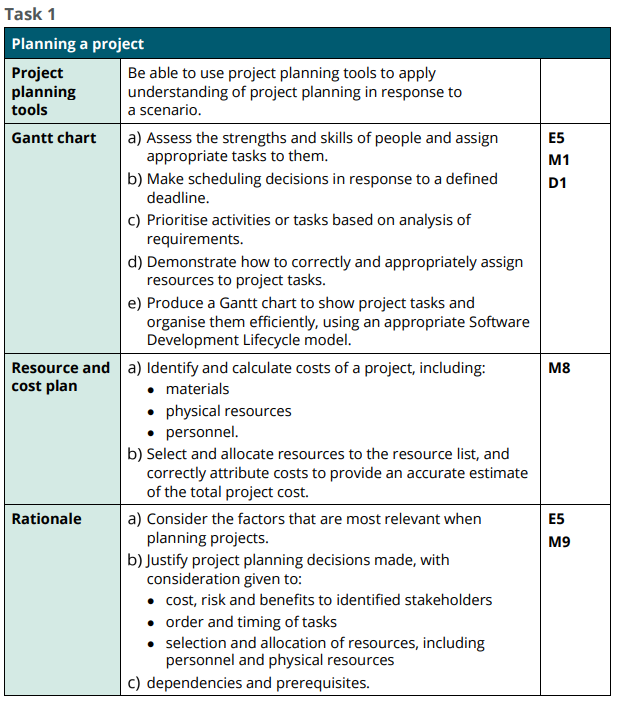
- Assess the strengths and skills of people and assign appropriate tasks to them.
- Make scheduling decisions in response to a defined deadline.
- Prioritise activities or tasks based on analysis of requirements.
- Demonstrate how to correctly and appropriately assign resources to project tasks.
- Use an appropriate project management methodology to efficiently organise project tasks.
Exam Guidance, Considerations and Tips
- There should be sensible use of concurrent and serial tasks; for example:
Infrastructure can be installed in both office spaces at the same time, but subsequent tasks may rely on single tasks, e.g. installing the infrastructure and server before accounts and security can be configured
- It would be sensible to test the connectivity BEFORE PCs are being installed; however, the plan could be organised to utilise the JNE to be building the PCs while the senior is testing and configuring.
- Tasks are relatively short so unlikely to break down further, but testing and fixing tests should be spread out between tasks, and at
sensible points.
- Expect some alignment of key milestones tasks and testing with fixing, e.g. it would be sensible to assume that a fault would be found when installing and testing the server and infrastructure, or minor faults found when building/configuring end user devices.
- There is no single correct way to organise the plan, but task orders should be sensible.
- Deadlines are not achievable if all tasks are done in a linear fashion; however, deadlines can be achieved quite comfortably with concurrent installation at each location.
- Depending on allocation of staff, some tasks could be over-allocated total hours (e.g. regression testing of a minor fault is 4 hours but could be doubled if allocated to both juniors – this could build in natural contingency and fail safes). Consideration of contingency, splitting of tasks in the sub-task/notes column of the plan
- Although some use of parallel tasks would be needed it may also be sensible to offset the start of the installation of one office space until the other is already under way. Adding a slight delay with mirrored tasks would help reduce issues further down the line, i.e. an issue that has occurred in one office could be pre-empted/mitigated as a solution may have already been found.
Resource and cost plan
What is a Resource and Cost Plan, why we need them, and, how to lay them out
A resource and cost plan is a structured document used in project planning to identify, allocate, and calculate the resources required to complete a project, alongside the total financial cost of delivering it.
In the planning of a project you must identify human resources (staff), physical resources (hardware/devices), and associated costs (labour and equipment) to determine the feasibility and affordability of a solution .
A high-quality plan demonstrates not only accurate costing, but also justified decision-making, ensuring that staff are assigned appropriately based on skill level, equipment choices are suitable for the scenario, and the overall project reflects realistic constraints such as budgets, time, and operational requirements.
Resource and cost plans are used to:
- Ensure a project is financially viable, identifying whether it can realistically be delivered within budget
- Allocate resources efficiently, ensuring the right people and equipment are used in the right places
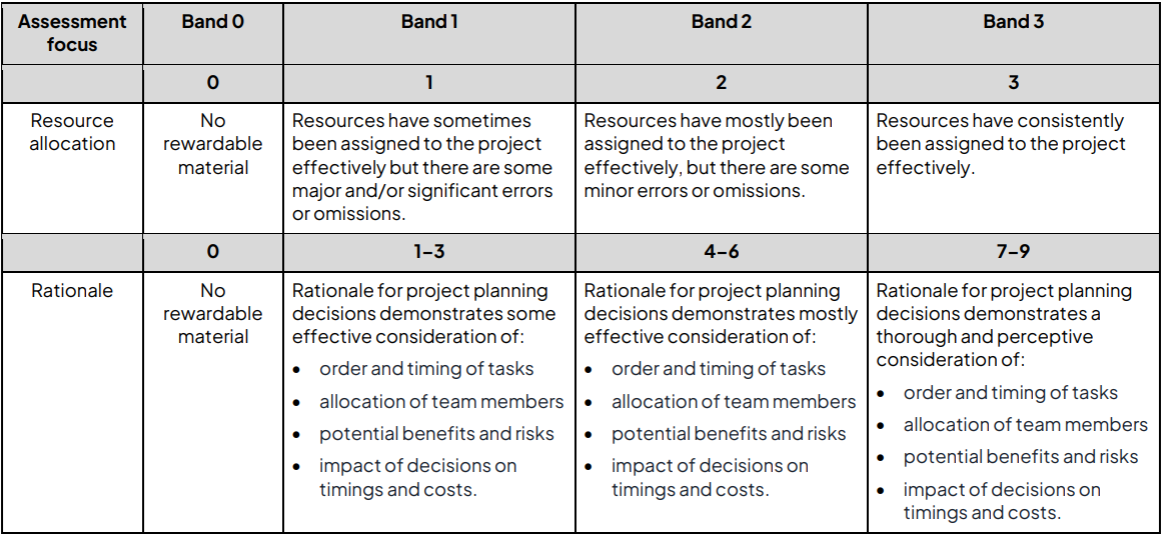
Identify and calculate costs of a project, including:
o materials
o physical resources
o personnel.
- Select and allocate resources to the resource list, and correctly attribute costs to provide an accurate estimate of the total project cost.
- Determine the affordability and viability of implementing a project and its impact on a company over time
Example of Human resources table of assets
| Staff Role | Staff Name | Daily Rate (£) |
|---|---|---|
| Senior Network Engineer (SNE) | Joe Bloggs | £35 |
| Junior Network Engineer (JNE1) | Anne Other | £20 |
| Junior Network Engineer (JNE2) | John Doe | £20 |
- Staff allocation- staff should be assigned based on task requirements, skills level and availability. There should be a clear rationale for who is assigned to which task.
- Cost of labour - students should calculate the total cost of labour based on hourly rates and the time each staff member is assigned to a task. Costs should be calculated using ONLY the number of days that were worked and NOT the total number of days of the project.
- Choice of server – students should indicate which of the servers they have chosen (this should also be detailed in their rationale). The calculations should show that they have chosen ONLY ONE of the servers.
- End user devices - students should detail the cost of which end user devices they have chosen PC/Laptop (or a combination).
- Total cost of project is approximate and depends on the allocation of staff, choice of server and choice of laptop/PC etc. Even choosing the cheaper options for server and end user devices, the project cannot be delivered within budget.
- Maintenance costs "
Rationale
What is a Rationale, why we need it, and how to lay it out
A rationale is a written explanation that justifies the decisions made within a project plan, showing clear reasoning for why specific approaches, task orders, resource allocations, and cost choices were selected. This part of the task looks to explain why the Gantt chart and resource/cost plan have been structured in a particular way, including consideration of task sequencing, staff allocation, risks, and financial decisions. A high-quality rationale demonstrates not just what has been planned, but the ability to think critically about efficiency, feasibility, and real-world IT practices, showing how the plan meets deadlines while managing risks and constraints.
A rationale is used to:
- Explain and justify your decisions, showing the examiner that your plan is logical and not random
- Demonstrate higher-level thinking, including awareness of risks, constraints, and alternative approaches
- Consider the factors that are most relevant when planning projects.
- Justify notable project planning decisions made (particularly those that will have a significant impact on the outcomes of the project), with consideration given to:
o order and timing of tasks
o allocation of team members
o potential benefits and risks
o impact of decisions on timings and costs.
The rationale will show reasoning for the chosen project development approach demonstrated in the project plan and points the students may consider, although some of these will vary depending on the choices students make in terms of organisation. These include but are not limited to:
• Task sequencing - students must justify the sequence of tasks, ensuring that all dependencies are considered. For example:
o installing the wireless access points before the main infrastructure and server wouldn’t be sensible. Also, the server would need to be in place before access and permissions were configured
o the reasoning behind choosing the order in which to update the offices and how/why they have organised the tasks to hit the deadline. For example, installing the infrastructure in both offices simultaneously with the SNE allocated to one office space and the juniors to another would make sense. While there is some risk with this, i.e. having the juniors work on a new install without direct supervision, they are all within the same building so the senior could support as needed. Adding a small amount of contingency time to allow for this would be sensible. Look for students to explore this.
• Risks - students must address potential risks in their planning, such as:
o the possibility of delays due to staff unavailability or unexpected network issues (have they allocated contingency time?)
o possible need to split the team so the installation could happen in both office spaces concurrently – causes issues as senior staff may not be able to oversee junior level workers
o Gwendolen Sandar – is very inexperienced so may need additional time and support
o Cledwyn Trumann – this is quite a hardware reliant project and they have only limited recent experience of physical infrastructure, which may lead to errors and/or delays
o Denise Wilkinson – inexperienced as a team leader so may not adequately support junior members of the team who will require support owing to their own inexperience. This could result in poor-quality outcomes.
• Cost justification - students must justify resource choices and associated costs including:
o opting for more/less expensive solutions (e.g. more expensive server as digital media and creative software are very resource intensive, desktops are cheaper and possibly better for the tasks at hand, but workers cannot move around/work remotely)
o allocation of staff hours – impact of doubling up staff and/or building in contingency time
o maintenance – how they predicted the cost of maintenance. Did they assume the minimum or maximum predicted number; what is the risk of it being outside of the allocated maintenance budget?
Last Updated
2026-05-01 11:08:55
English and Maths
English
Maths
Stretch and Challenge
Stretch and Challenge
Homework
Homework
Equality and Diversity Calendar
How to's
How to's Coverage
Links to Learning Outcomes |
Links to Assessment Criteria |
|
|---|---|---|
Files that support this week
→
Next